
















Dummynation









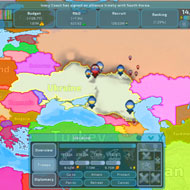
What actually happens once you’re handed a country with no restrictions and one open-ended goal — world domination? That’s the question Dummynation puts in front of you from the first turn, and the answer turns out to be a lot more about balancing your own economy than it is about simply steamrolling every neighbor on the map.
One Country, No Restrictions, One Goal in Dummynation
Dummynation hands you full control over a nation and lets the path to domination be whatever you make of it. Military occupation is the most direct route, but it isn’t the only one — diplomatic manipulation can pull rival countries into conflicts that weaken them without your army ever crossing a border. Both routes exist side by side, and switching between them mid-game is part of what keeps a single playthrough from feeling like a straight march across the map.
The organic border system is worth calling out specifically: territory doesn’t snap to a grid the way it does in a lot of strategy games, so expansion looks and feels closer to how a real map redraws itself than to a puzzle grid filling in.
Where Most Campaigns Actually Fall Apart
The most common way a Dummynation campaign stalls out isn’t losing a war outright — it’s overspending on a military campaign faster than the economy can support it. Research and military upkeep both draw from the same resource pool, and falling behind rivals in that balance is what usually turns a strong opening into a losing position by the mid-game.
- Expanding territory faster than infrastructure can support tends to leave new regions underdeveloped and vulnerable.
- Ignoring diplomacy in favor of pure military pressure invites coalitions against you rather than isolated conflicts you can manage one at a time.
- Pouring resources into research too early, before territory is secure, can leave a campaign with strong tech and not enough land to use it on.
Diplomacy as a Weapon, Not Just a Shield
Manipulating diplomatic relations in Dummynation isn’t only defensive. Provoking two rival nations into fighting each other, then moving in once both are weakened, is a recognized approach among experienced players — one that trades direct combat risk for patience and timing. It’s a slower path to domination, but it tends to leave your own military and economy in far better shape than a campaign built entirely on direct invasion.
- Identify two rivals with existing tension rather than starting a conflict from scratch.
- Use diplomatic pressure to escalate that tension without committing your own forces.
- Move in once both sides have spent resources weakening each other.
The Multiplayer Battle Royale Layer
Outside the main campaign, Dummynation’s multiplayer mode reframes the same systems as a large-scale battle royale against other players instead of AI-controlled rivals. The economic balancing act stays the same, but the unpredictability of human opponents making their own diplomatic and military choices changes the pacing considerably compared to a solo campaign against fixed AI behavior.
How long does a typical Dummynation campaign take to reach world domination?
There’s no fixed length — it depends heavily on whether a player leans on rapid military expansion or the slower diplomatic-manipulation approach, with the latter generally taking longer but costing less in resources along the way.
Is military conquest necessary to win, or can diplomacy alone get you there?
Diplomacy can weaken and destabilize rivals significantly, but some direct territorial control is still typically required to complete domination rather than relying on manipulation alone.
What’s the biggest difference between the campaign and the battle royale mode?
The battle royale mode replaces predictable AI rivals with other players making their own economic and military decisions, which makes the same core systems play out far less predictably than a solo campaign against fixed opponents.
Dummynation’s real challenge was never conquering the map by force — it’s holding the balance between military ambition and economic survival long enough that domination stops being a fantasy and starts being the logical next move.
Comments
There are no reviews yet. Be the first one to write one.