
















TAXINAUT







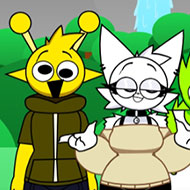
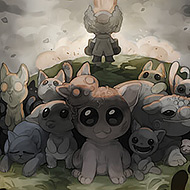
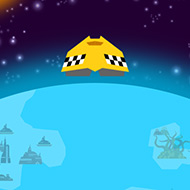
What’s it actually like to drive a cab through a galaxy that doesn’t care whether you make rent this week? TAXINAUT answers that question by putting you behind the wheel of a working-class spaceship with over a hundred thousand star systems to get lost in, and not one of them particularly interested in making your life easier.
| Genre | Open-World Sci-Fi Taxi RPG |
| Star Systems | 100,000+ |
| Main Storyline | 30+ hours, plus 4 secondary storylines |
| Traversal | Seamless planet-to-space, no loading screens |
A Working-Class Job in a Galaxy That Doesn’t Owe You Anything
TAXINAUT frames its entire premise around a job most sci-fi games treat as background flavor: driving passengers where they need to go and getting paid for it. There’s no chosen-one framing here. You’re a taxi driver first, and every storyline the game hands you grows out of that occupation rather than around it. Beginners who expect a traditional space-opera arc tend to be thrown by how mundane the framing stays even as the stakes around individual passengers escalate dramatically.
Early fares are simple, point to point, low stakes, a way to learn how the ship handles before the game trusts you with passengers whose stories carry real weight.
Flying From a Planet’s Surface Into Open Space
The traversal system is one of TAXINAUT’s most consistently praised features: you can descend from orbit onto a planet’s surface, land, pick up a fare, and ascend back into open space to warp toward another system, all without a single loading screen breaking the illusion. That seamlessness changes how you plan routes. A fare that looks like a quick planetary hop might actually be faster as an orbital cut across a system’s edge, and reading the map that way is a skill the game expects you to develop rather than teaches directly.
Over a Hundred Thousand Systems, and Most of Them Are Quiet
The scale here isn’t decoration. With more than one hundred thousand star systems containing planets and stations, most of what you fly past has no scripted content waiting in it, and new players often assume that means the game is padded. It isn’t, exactly — the emptiness is part of what sells the working-class framing, since a real cab driver’s galaxy would be mostly quiet stretches between the fares that actually matter.
What TAXINAUT Doesn’t Soften
It would be dishonest to cover this game without naming its subject matter directly. TAXINAUT’s underbelly setting engages with sexual exploitation, slavery, drug and alcohol abuse, the organ trade, and violent crime as ongoing elements of the world your passengers come from, not as shock moments dropped in for effect. This is, by a wide margin, the most divisive aspect of the game in community discussion.
Some players consider the unflinching treatment of these themes the thing that separates TAXINAUT from a sanitized space-opera pastiche — the passengers feel like they come from somewhere real because the world doesn’t look away from what shaped them. Others find the sustained bleakness exhausting across a long session and recommend spacing out story-heavy fares rather than chaining them back to back. Neither reaction is wrong, and the game doesn’t seem interested in resolving that tension for you.
The Main Storyline Versus the Four Side Threads
Beyond the thirty-plus hour main storyline, four secondary storylines run in parallel, each following different passenger threads that intersect with the main plot without depending on it directly. Players chasing full completion tend to interleave these rather than clearing them sequentially, since several fares reference events from more than one storyline at once, and playing them in isolation strips some of that context out.
Advanced Techniques Most New Pilots Miss
- Fuel and time pressure both scale with route choice, so the fastest visible path isn’t always the most efficient one once fuel cost is factored in.
- Passenger dialogue during a long flight often previews what a later fare from the same faction will actually need from you.
- Docking at a station without a fare queued still exposes rumors and job leads that never show up on the main job board.
Who Actually Sticks With TAXINAUT
Explorer-minded players gravitate toward the sheer scale of its star systems, happy to burn an evening drifting through quiet space just to see what’s out there.
Narrative-focused players lean the opposite direction, treating each fare as a short story and caring less about the empty space between them than about what a single passenger reveals about the system they just left.
Questions New Pilots Ask
Do I need to complete all four secondary storylines to finish TAXINAUT?
No — the main storyline stands on its own, though the secondary threads add context to passengers and factions that the main plot references without fully explaining.
Is combat a major part of TAXINAUT, or is it mostly driving and dialogue?
It leans heavily toward driving, navigation, and passenger interaction rather than combat, though violent crime as a setting element does mean confrontation shows up in specific fares rather than as a constant system.
How does the seamless planet-to-space transition affect route planning?
It rewards thinking in three dimensions rather than following a flat map, since a route that cuts through orbital space can beat a purely surface-level path even when the surface route looks shorter on paper.
TAXINAUT never lets you forget that every fare is someone’s whole situation, not just a waypoint on your map. By the time the meter stops running on a passenger you’ve spent an hour driving across three systems, the galaxy feels a lot smaller and a lot heavier than it did at the start of the shift.
Comments
There are no reviews yet. Be the first one to write one.